
Blog

  • Top Government Medical Colleges in India (2026 Guide)

    Top Government Medical Colleges in India (2026 Guide)

    Top Government Medical Colleges in India (2026 Guide)

    Choosing the right medical college is one of the most important decisions for every NEET aspirant. India is home to several prestigious government medical institutions that offer world-class education, experienced faculty, advanced research facilities, and excellent clinical exposure—all at an affordable fee.

    Most admissions to government medical colleges are based on the NEET UG examination, followed by centralized counseling conducted through the Medical Counselling Committee (MCC) and respective state authorities.

    Below is a list of some of the best government medical colleges in India based on academic reputation, research output, hospital infrastructure, clinical exposure, faculty quality, and recent national rankings.

    1. All India Institute of Medical Sciences (AIIMS), New Delhi

    AIIMS New Delhi is widely regarded as India’s best medical college and has consistently secured the top position in the National Institutional Ranking Framework (NIRF). It is known for exceptional academics, cutting-edge research, and one of the country’s finest hospitals.

    Highlights

    • Established: 1956
    • Location: New Delhi
    • Entrance: NEET UG
    • Famous for: MBBS, MD, MS, DM, MCh
    • World-class research facilities
    • Extremely affordable tuition fees
    • Outstanding placement and postgraduate opportunities

    2. Post Graduate Institute of Medical Education and Research (PGIMER), Chandigarh

    PGIMER is one of India’s premier government medical institutes, especially renowned for postgraduate education and medical research. It also offers limited undergraduate medical programs through national-level admissions.

    Highlights

    • Excellent research ecosystem
    • Advanced tertiary care hospital
    • Highly experienced faculty
    • Strong reputation in medical specialties

    3. Jawaharlal Institute of Postgraduate Medical Education and Research (JIPMER), Puducherry

    JIPMER combines excellent academic standards with outstanding patient exposure. The institute offers modern infrastructure and is consistently ranked among India’s top medical institutions.

    Highlights

    • Established in 1823
    • Central Government Institute
    • Affordable fees
    • Excellent campus facilities
    • Strong research opportunities

    4. Banaras Hindu University – Institute of Medical Sciences (IMS-BHU)

    Located in Varanasi, IMS-BHU is among India’s oldest and most respected medical institutions. It provides excellent clinical training through Sir Sunderlal Hospital and has a long history of producing skilled healthcare professionals.

    Highlights

    • Excellent academic reputation
    • Large teaching hospital
    • Affordable education
    • Strong alumni network

    5. Sanjay Gandhi Postgraduate Institute of Medical Sciences (SGPGIMS), Lucknow

    SGPGIMS is internationally recognized for advanced medical education, super-specialty healthcare, and biomedical research.

    Highlights

    • Advanced medical research
    • State-of-the-art laboratories
    • Excellent postgraduate programs
    • High-quality patient care

    6. Maulana Azad Medical College (MAMC), New Delhi

    MAMC is one of India’s most competitive government medical colleges for MBBS admissions. Students receive extensive clinical exposure through multiple associated hospitals in Delhi.

    Highlights

    • Top NEET cut-offs
    • Multiple teaching hospitals
    • Excellent internship opportunities
    • Strong academic environment

    7. King George’s Medical University (KGMU), Lucknow

    KGMU is one of India’s oldest medical universities and offers excellent undergraduate, postgraduate, and super-specialty medical education.

    Highlights

    • Historic institution
    • Modern hospital facilities
    • Excellent faculty
    • Strong research programs

    8. Lady Hardinge Medical College (LHMC), New Delhi

    Established in 1916, Lady Hardinge Medical College is well known for quality medical education and excellent patient exposure through affiliated hospitals.

    Highlights

    • Government-funded
    • Excellent faculty
    • Affordable fees
    • Strong clinical training

    9. Madras Medical College, Chennai

    Madras Medical College is among India’s oldest medical colleges and continues to maintain high academic standards with excellent healthcare facilities.

    Highlights

    • Established in 1835
    • Rich academic heritage
    • Excellent hospital network
    • Strong postgraduate education

    10. Seth G. S. Medical College, Mumbai

    Affiliated with KEM Hospital, Seth GS Medical College offers exceptional clinical exposure because of its high patient volume and advanced medical facilities.

    Highlights

    • Premier government institution
    • Excellent internship opportunities
    • Strong research culture
    • Highly competitive admissions

    Why Choose a Government Medical College?

    Government medical colleges offer several advantages over many private institutions.

    Some key benefits include:

    • Affordable tuition fees
    • Experienced faculty
    • Large teaching hospitals
    • Better clinical exposure
    • Modern laboratories
    • Strong research opportunities
    • High reputation among employers
    • Better postgraduate preparation

    For many students, government colleges provide the best return on investment due to their low fees and excellent academic standards.

    Admission Process

    Admission to MBBS programs in government medical colleges generally follows these steps:

    1. Qualify the NEET UG examination.
    2. Participate in MCC All India Quota or State Counseling.
    3. Fill and lock college preferences.
    4. Seat allotment based on NEET rank, category, and seat availability.
    5. Document verification and admission.

    Higher NEET scores significantly improve the chances of securing admission to top institutions such as AIIMS, JIPMER, MAMC, and IMS-BHU.

    Factors to Consider Before Choosing a College

    While rankings are important, students should also evaluate:

    • Clinical exposure
    • Hospital patient load
    • Faculty quality
    • Research opportunities
    • Hostel facilities
    • Campus environment
    • Internship experience
    • PG preparation support
    • Alumni network
    • Location and accessibility

    Choosing a college that aligns with your academic goals and career aspirations is often more important than relying solely on rankings.

    Conclusion

    India’s government medical colleges continue to provide some of the highest-quality medical education in the country. Institutions such as AIIMS New Delhi, PGIMER Chandigarh, JIPMER Puducherry, IMS-BHU, SGPGIMS Lucknow, MAMC Delhi, KGMU Lucknow, LHMC Delhi, Madras Medical College, and Seth GS Medical College consistently attract the country’s top NEET performers.

    Before making your final decision, compare each college’s infrastructure, faculty, hospital exposure, research opportunities, and recent counseling trends. A well-informed choice can lay the foundation for a successful and rewarding medical career. Recent NIRF rankings continue to place AIIMS New Delhi at the top, followed by institutions such as PGIMER Chandigarh and JIPMER Puducherry among the leading government medical colleges in India.

  • Top 10 AI Tools Every Student Should Use in 2026

    Top 10 AI Tools Every Student Should Use in 2026

    Top 10 AI Tools Every Student Should Use in 2026

    Artificial Intelligence has become an essential part of modern education. What once seemed like futuristic technology is now helping millions of students learn faster, write better, organize their studies, and prepare for exams more efficiently. From AI-powered tutors to research assistants and productivity tools, students today have access to resources that were unimaginable just a few years ago.

    However, the key to success is not using AI to complete assignments automatically but using it to improve understanding, save time, and develop stronger academic skills. This article explores ten categories of AI tools that can help students become smarter, more productive learners in 2026.

    1. AI Chat Assistants

    AI chat assistants have become one of the most valuable learning companions for students. They can explain difficult concepts, answer academic questions, generate examples, summarize lessons, and provide step-by-step solutions for many subjects.

    Whether you’re studying mathematics, history, biology, economics, or computer science, AI assistants can simplify complex topics into easy-to-understand explanations. Students can also ask follow-up questions, making learning feel more like a conversation than a traditional search.

    To get the best results, students should ask specific questions and request explanations rather than simply copying answers.

    2. AI Writing Assistants

    Writing essays, reports, and research papers requires strong communication skills. AI writing assistants help students improve grammar, sentence structure, vocabulary, and readability.

    These tools can:

    • Correct grammatical mistakes
    • Improve sentence flow
    • Suggest stronger vocabulary
    • Rewrite awkward paragraphs
    • Check clarity and tone

    Instead of replacing original writing, AI should be used as an editor that helps students communicate more effectively.

    3. AI Note-Taking Tools

    Many students struggle to organize classroom notes. AI-powered note-taking applications can automatically summarize lectures, highlight important points, create searchable notes, and organize information into structured formats.

    Some tools can even convert voice recordings into text, making revision much easier.

    Well-organized notes reduce revision time and improve long-term retention.

    4. AI Research Assistants

    Finding reliable information online can be time-consuming. AI research assistants help students discover relevant academic resources, summarize lengthy articles, compare different viewpoints, and organize research materials.

    These tools save hours of manual searching while helping learners focus on understanding ideas instead of collecting information.

    Students should always verify important facts using trusted academic sources and institutional references.

    5. AI Language Learning Platforms

    Learning a new language has become more interactive thanks to AI.

    Modern language-learning tools provide:

    • Pronunciation feedback
    • Grammar correction
    • Vocabulary practice
    • Interactive conversations
    • Listening exercises
    • Personalized learning paths

    Students receive immediate corrections, allowing them to improve speaking and writing skills much faster than traditional methods alone.

    6. AI Productivity and Planning Tools

    Time management is one of the biggest challenges students face.

    AI productivity tools help users:

    • Create study schedules
    • Prioritize assignments
    • Set reminders
    • Track goals
    • Break large projects into smaller tasks

    By analyzing deadlines and workloads, these tools recommend efficient study plans that reduce stress and improve consistency.

    Good planning often leads to better academic performance.

    7. AI Quiz and Flashcard Generators

    Revision becomes more effective when students actively test themselves.

    AI can instantly convert textbook chapters, lecture notes, or PDFs into:

    • Flashcards
    • Multiple-choice questions
    • Practice quizzes
    • Fill-in-the-blank exercises
    • Revision summaries

    Self-testing improves memory retention and helps students identify weak areas before examinations.

    8. AI Coding Assistants

    Programming students now have access to AI coding assistants that explain programming concepts, identify coding errors, suggest improvements, and generate sample code for learning purposes.

    Instead of simply fixing mistakes, these assistants explain why the code works or fails, helping students become better programmers over time.

    Learning by understanding remains far more valuable than copying code.

    9. AI Presentation Tools

    Creating attractive presentations often takes hours.

    AI presentation tools help students:

    • Design professional slides
    • Suggest layouts
    • Generate visual elements
    • Organize information
    • Create speaker notes

    These tools allow students to spend more time preparing their ideas instead of adjusting fonts, colors, and formatting.

    Clear communication is just as important as strong content.

    10. AI Exam Preparation Platforms

    Preparing for examinations becomes easier with AI-powered revision platforms.

    These systems analyze a student’s progress and recommend personalized revision plans based on strengths and weaknesses.

    Common features include:

    • Adaptive practice tests
    • Performance analytics
    • Topic-wise revision
    • Difficulty adjustment
    • Instant feedback

    Rather than studying everything equally, students can focus on areas that require the most improvement.

    Responsible Use of AI

    Although AI offers remarkable benefits, students should avoid relying on it for completing assignments without understanding the material.

    Responsible AI use includes:

    • Using AI to learn, not to cheat.
    • Verifying important information.
    • Practicing independently.
    • Thinking critically about AI-generated responses.
    • Giving proper credit when required by academic institutions.

    AI should enhance education—not replace genuine effort and curiosity.

    The Future of Student Learning

    As artificial intelligence continues to evolve, future educational tools will become even more personalized. AI may soon provide real-time tutoring through voice conversations, immersive virtual learning environments, and adaptive courses that continuously adjust to each student’s progress.

    Educational institutions are increasingly integrating AI into classrooms, libraries, and online learning platforms. Students who learn how to use these technologies responsibly will be better prepared for higher education and future careers.

    Conclusion

    Artificial Intelligence is transforming education by making learning more accessible, interactive, and personalized. From intelligent chat assistants and writing tools to research platforms and exam preparation systems, AI helps students study more efficiently while improving their understanding of complex subjects.

    The most successful learners in 2026 will not be those who depend entirely on AI, but those who use it wisely to strengthen their skills, expand their knowledge, and become lifelong learners. By combining human curiosity with intelligent technology, students can unlock new opportunities for academic and personal growth.

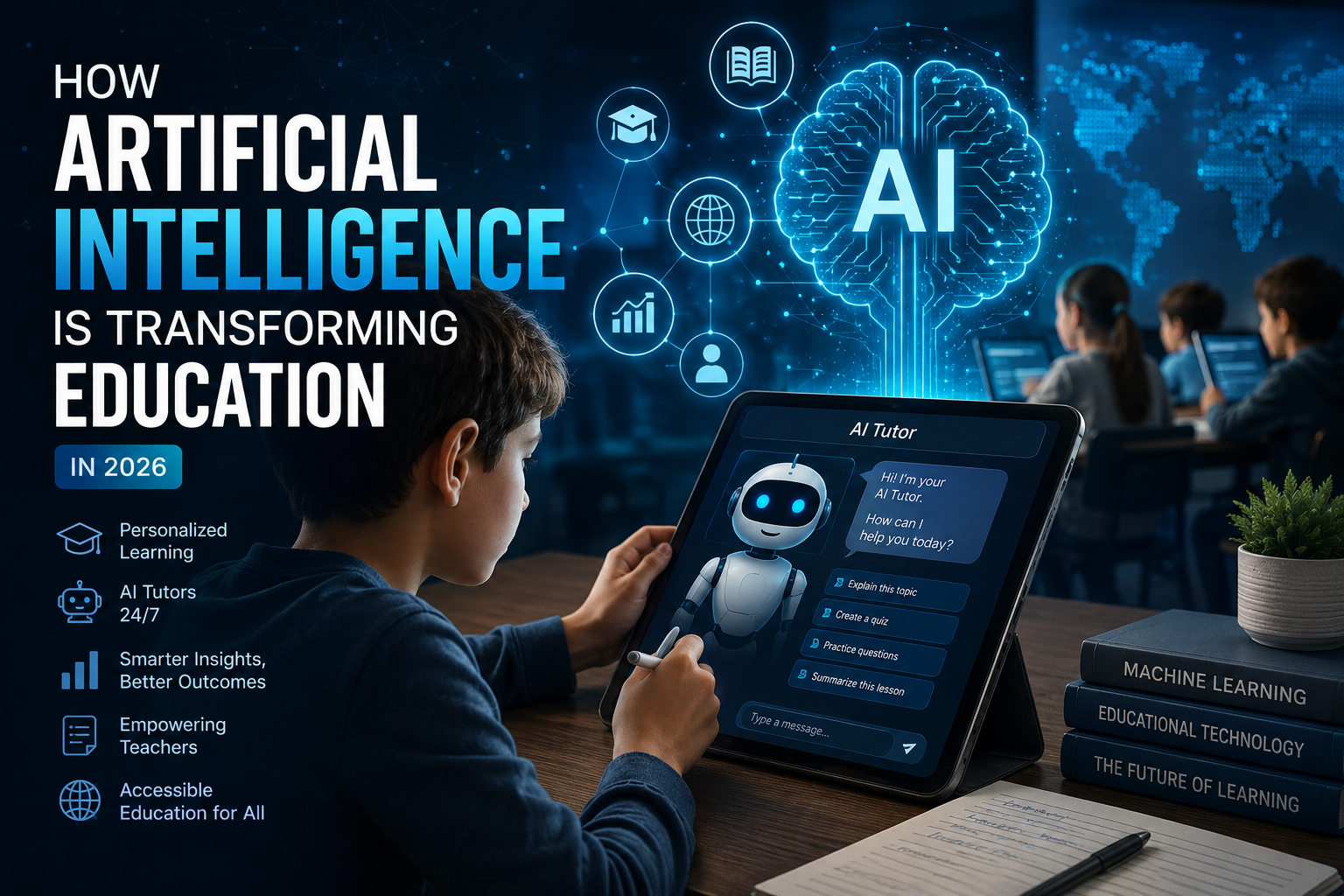
  • How Artificial Intelligence Is Transforming Education in 2026

    How Artificial Intelligence Is Transforming Education in 2026

    The Future of Education: How AI Is Transforming Education in 2026

    Artificial Intelligence (AI) is no longer a futuristic concept. It has become an essential part of modern education, helping students learn more effectively and enabling teachers to create engaging learning experiences. From personalized tutoring to automated grading, AI is reshaping classrooms around the world.

    As educational institutions continue adopting digital technologies, AI is becoming one of the most powerful tools for improving learning outcomes. Rather than replacing teachers, AI supports them by handling repetitive tasks and providing valuable insights into student performance.

    Personalized Learning for Every Student

    One of the greatest advantages of AI in education is personalized learning. Every student learns at a different pace. Traditional classrooms often struggle to meet the needs of every learner, especially when some students need additional support while others are ready for advanced material.

    AI-powered learning platforms analyze a student’s strengths, weaknesses, and learning patterns. Based on this information, they recommend customized lessons, quizzes, and exercises. Students receive instant feedback, allowing them to improve before moving to the next topic.

    This personalized approach increases confidence and helps students achieve better academic results.

    AI Tutors Available 24/7

    Virtual AI tutors have become increasingly popular in recent years. Unlike traditional tutoring, AI assistants are available anytime, allowing students to ask questions whenever they need help.

    These digital tutors can explain mathematical concepts, solve programming problems, assist with grammar, summarize lengthy chapters, and even generate practice questions for exams.

    For students preparing for competitive examinations, having round-the-clock academic support can significantly improve consistency and productivity.

    Helping Teachers Save Time

    Teachers spend a considerable amount of time grading assignments, preparing lesson plans, and managing administrative work. AI can automate many of these repetitive tasks.

    Modern educational platforms can:

    • Grade multiple-choice tests automatically.
    • Generate quizzes within seconds.
    • Create lesson plans based on curriculum standards.
    • Analyze classroom performance.
    • Identify students who may need additional support.

    With routine work reduced, teachers can dedicate more time to mentoring students and designing engaging classroom activities.

    Smarter Content Creation

    AI is also changing how educational content is created.

    Educators can generate worksheets, reading passages, presentations, flashcards, and question banks in minutes. AI writing assistants help improve grammar, simplify difficult concepts, and adapt content for different age groups.

    Video creators can use AI to generate subtitles, voiceovers, educational animations, and visual explanations without requiring expensive production teams.

    As a result, high-quality educational resources are becoming more accessible than ever before.

    Language Learning Becomes Easier

    Learning a new language often requires continuous practice. AI-powered language learning applications provide instant pronunciation feedback, conversational practice, vocabulary exercises, and grammar corrections.

    Students can interact with AI chatbots that simulate real-life conversations, making language learning more interactive and enjoyable.

    Speech recognition technology has also improved dramatically, allowing learners to practice speaking with greater confidence.

    Data-Driven Learning Insights

    Educational institutions collect large amounts of learning data. AI helps convert this information into meaningful insights.

    Schools can identify:

    • Students at risk of falling behind.
    • Frequently misunderstood topics.
    • Learning trends across classrooms.
    • Effectiveness of teaching methods.
    • Attendance and engagement patterns.

    These insights help educators make informed decisions and improve academic performance across entire institutions.

    AI in Online Education

    Online learning has expanded rapidly over the past few years. AI plays a central role in making digital education more engaging.

    Modern online learning platforms use AI to:

    • Recommend courses based on interests.
    • Adjust lesson difficulty automatically.
    • Generate personalized study schedules.
    • Provide instant doubt resolution.
    • Track learning progress through dashboards.

    Students benefit from a more interactive and adaptive learning environment that closely resembles one-on-one tutoring.

    Challenges and Ethical Considerations

    Despite its many advantages, AI in education also presents several challenges.

    Privacy remains one of the biggest concerns. Educational platforms collect student data, making secure storage and responsible usage extremely important.

    There is also the issue of bias. AI systems are only as good as the data used to train them. Poor-quality data can lead to inaccurate recommendations or unfair assessments.

    Additionally, educators must ensure that students continue developing critical thinking and problem-solving skills rather than relying entirely on AI-generated answers.

    Responsible implementation is essential for maximizing the benefits of AI while minimizing potential risks.

    The Future of AI in Education

    The future of education will likely combine human expertise with artificial intelligence.

    Instead of replacing teachers, AI will act as a powerful teaching assistant that handles repetitive tasks, provides personalized support, and helps educators better understand student needs.

    Emerging technologies such as augmented reality, virtual reality, adaptive assessments, intelligent tutoring systems, and AI-generated simulations will further transform classrooms over the next decade.

    Students will have access to highly personalized learning experiences regardless of their location or economic background.

    Conclusion

    Artificial Intelligence is revolutionizing education by making learning more personalized, accessible, and efficient. From intelligent tutoring systems to automated grading and adaptive learning platforms, AI is helping students learn smarter while allowing teachers to focus on what matters most—teaching and mentoring.

    As educational technology continues evolving, the most successful institutions will be those that combine innovative AI tools with skilled educators and thoughtful teaching practices. The goal is not to replace human interaction but to enhance it, creating a future where every learner has the opportunity to reach their full potential.