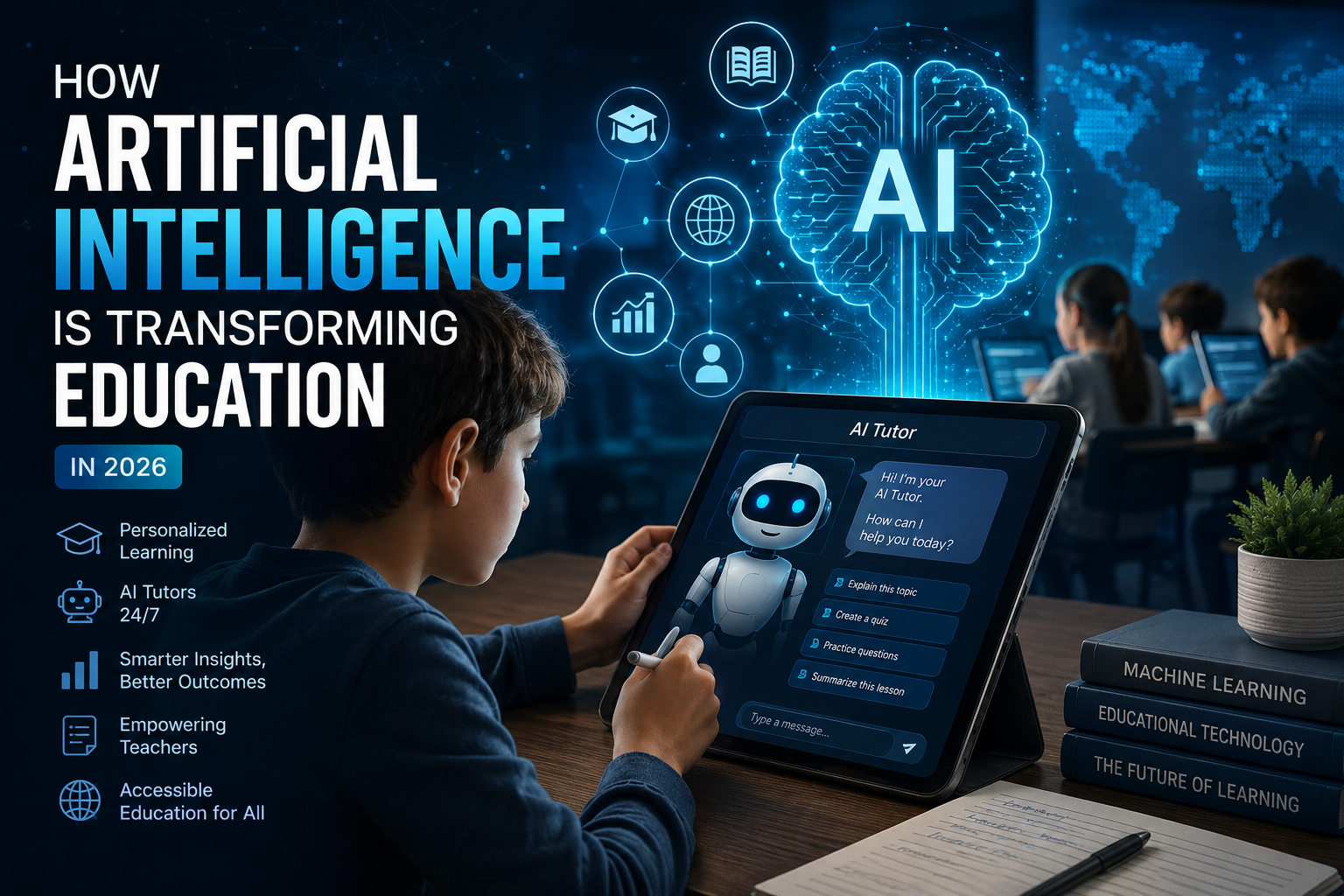
The Future of Education: How AI Is Transforming Education in 2026
Artificial Intelligence (AI) is no longer a futuristic concept. It has become an essential part of modern education, helping students learn more effectively and enabling teachers to create engaging learning experiences. From personalized tutoring to automated grading, AI is reshaping classrooms around the world.
As educational institutions continue adopting digital technologies, AI is becoming one of the most powerful tools for improving learning outcomes. Rather than replacing teachers, AI supports them by handling repetitive tasks and providing valuable insights into student performance.
Personalized Learning for Every Student
One of the greatest advantages of AI in education is personalized learning. Every student learns at a different pace. Traditional classrooms often struggle to meet the needs of every learner, especially when some students need additional support while others are ready for advanced material.
AI-powered learning platforms analyze a student’s strengths, weaknesses, and learning patterns. Based on this information, they recommend customized lessons, quizzes, and exercises. Students receive instant feedback, allowing them to improve before moving to the next topic.
This personalized approach increases confidence and helps students achieve better academic results.
AI Tutors Available 24/7
Virtual AI tutors have become increasingly popular in recent years. Unlike traditional tutoring, AI assistants are available anytime, allowing students to ask questions whenever they need help.
These digital tutors can explain mathematical concepts, solve programming problems, assist with grammar, summarize lengthy chapters, and even generate practice questions for exams.
For students preparing for competitive examinations, having round-the-clock academic support can significantly improve consistency and productivity.
Helping Teachers Save Time
Teachers spend a considerable amount of time grading assignments, preparing lesson plans, and managing administrative work. AI can automate many of these repetitive tasks.
Modern educational platforms can:
- Grade multiple-choice tests automatically.
- Generate quizzes within seconds.
- Create lesson plans based on curriculum standards.
- Analyze classroom performance.
- Identify students who may need additional support.
With routine work reduced, teachers can dedicate more time to mentoring students and designing engaging classroom activities.
Smarter Content Creation
AI is also changing how educational content is created.
Educators can generate worksheets, reading passages, presentations, flashcards, and question banks in minutes. AI writing assistants help improve grammar, simplify difficult concepts, and adapt content for different age groups.
Video creators can use AI to generate subtitles, voiceovers, educational animations, and visual explanations without requiring expensive production teams.
As a result, high-quality educational resources are becoming more accessible than ever before.
Language Learning Becomes Easier
Learning a new language often requires continuous practice. AI-powered language learning applications provide instant pronunciation feedback, conversational practice, vocabulary exercises, and grammar corrections.
Students can interact with AI chatbots that simulate real-life conversations, making language learning more interactive and enjoyable.
Speech recognition technology has also improved dramatically, allowing learners to practice speaking with greater confidence.
Data-Driven Learning Insights
Educational institutions collect large amounts of learning data. AI helps convert this information into meaningful insights.
Schools can identify:
- Students at risk of falling behind.
- Frequently misunderstood topics.
- Learning trends across classrooms.
- Effectiveness of teaching methods.
- Attendance and engagement patterns.
These insights help educators make informed decisions and improve academic performance across entire institutions.
AI in Online Education
Online learning has expanded rapidly over the past few years. AI plays a central role in making digital education more engaging.
Modern online learning platforms use AI to:
- Recommend courses based on interests.
- Adjust lesson difficulty automatically.
- Generate personalized study schedules.
- Provide instant doubt resolution.
- Track learning progress through dashboards.
Students benefit from a more interactive and adaptive learning environment that closely resembles one-on-one tutoring.
Challenges and Ethical Considerations
Despite its many advantages, AI in education also presents several challenges.
Privacy remains one of the biggest concerns. Educational platforms collect student data, making secure storage and responsible usage extremely important.
There is also the issue of bias. AI systems are only as good as the data used to train them. Poor-quality data can lead to inaccurate recommendations or unfair assessments.
Additionally, educators must ensure that students continue developing critical thinking and problem-solving skills rather than relying entirely on AI-generated answers.
Responsible implementation is essential for maximizing the benefits of AI while minimizing potential risks.
The Future of AI in Education
The future of education will likely combine human expertise with artificial intelligence.
Instead of replacing teachers, AI will act as a powerful teaching assistant that handles repetitive tasks, provides personalized support, and helps educators better understand student needs.
Emerging technologies such as augmented reality, virtual reality, adaptive assessments, intelligent tutoring systems, and AI-generated simulations will further transform classrooms over the next decade.
Students will have access to highly personalized learning experiences regardless of their location or economic background.
Conclusion
Artificial Intelligence is revolutionizing education by making learning more personalized, accessible, and efficient. From intelligent tutoring systems to automated grading and adaptive learning platforms, AI is helping students learn smarter while allowing teachers to focus on what matters most—teaching and mentoring.
As educational technology continues evolving, the most successful institutions will be those that combine innovative AI tools with skilled educators and thoughtful teaching practices. The goal is not to replace human interaction but to enhance it, creating a future where every learner has the opportunity to reach their full potential.
Leave a Reply